Posts

Showing posts with the label Reading

Games Testing

Image
  flickre Game testing is an important step in ensuring maximum performance and quality in the final output.The goal of game testing is to find defects and keep track of software products' documentation. Here are seven steps to game testing techniques.  1.Functionality testing  2.Combination  testing  3. Ad Hoc testing  4.Compatibility testing  5.Clean room tree  testing  6.Regression  testing  7.Performance  testing  I have learned that in this modern world, technological advancement is a constant, and the games business is frequently at the forefront of technological advancement. However, one must first acknowledge the need for so many tests, so that they will aid in the correction of important faults and make one's life more convenient. In this video the guy recommends  to start game testing as soon as you have a working prototype. I agree, at the beginning when I was creating my game I did not game test which lead...

Games Stories

Image
source: flickr While doing research and reading publications, I came to the conclusion that in order to build a unique and engaging narrative in your game, there must be a key denominator for the player to engage in. This article outlines what succeeded in previous story styles as well as what makes the new gaming tale type unique. A game isn't the same as a movie. While reading this , I noticed that there are several areas in game storylines where we've gone wrong so far. The bulk of the problems arise from common misunderstandings. 1. Dialog is the core of a story.  2.It makes absolutely no difference what the story is.  I knew including conflict in your story, whether you're creating it for any type of media is a must. From the start, conflict is a factor of the structure and embedding in the development process. I also discovered classical story structure should be examined by game creators because it is simple and effective. This tool will not spark your creativity,...

Week 9 Reading and Writing

Image
As I reminisce and reflect on the reading and writing tasks I have completed in this module I have gained a lot of knowledge about gaming and how to create a game. I never knew how much work goes into creating a game. When entering this module, I had little to no knowledge about gaming.  Now, when I play games I am analysing the game mechanics, the narrative, the level of difficulty and is the game engaging and so much more.  In the first stage of reading and writing, I was proposed with the question What is a game?.  I learned that question can be answered in several aspects. As I progress with my game, I always tend to look back on the notes I have created in Game Design. When creating my game I always consider this sentence. The components of a game: rules to action and storyline. If you want to have a captivating game, construct rules of what your player can or cannot do while playing the game.  Also during this reading, I learned about several different ways fo...

Reading - Game Fun

Image
  Picpedia.Org This week's first reading is titled "Gamification." What does having a good time have to do with it? focuses on gamification, yet the subjects they cover are also relevant to game creation. Fun is better described as "pleasurable engagement" in the context of games and gamification, as opposed to "passive" aesthetic enjoyment and entertainment. In this article I read Gamification design: what's fun got to do with it?  Marc LeBlanc's outlines 8 kinds of fun: Sensation - Game as sense pleasure  Fantasy -  Game as make believe  Narrative - Game as drama  Challenge - Game as obstacle course  Fellowship -  Game as social framework Discovery - Game as uncharted territory Expression - Game as self-discovery  Submission - Game as pastime I found LeBlanc's outlines of fun really helpful and easy to understand compared to the others in the article.  In the video A theory of fun for game design  the attractiveness of a game...

Games Decisions

Image
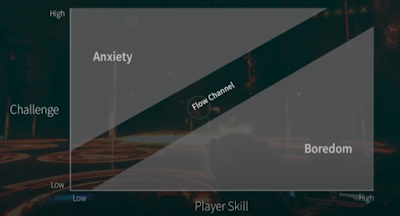
  Source In this weeks reading the flow theory in games is the theme for this week. Flow is critical for creating an interesting game for the audience providing pleasure for the player.  Flow is a psychological principle that we can apply to our game to create challenges that are both entertaining and appropriate for the player's skill level, allowing them to remain engaged in the game. We can utilise flow as a tool to assist improve our game in many ways by understanding things like this tiny diagram, and we can also have a framework for gameplay that is based on human psychology rather than winging it. We'll be working our way through Flow's straightforward progression. We aim to put a challenge in front of the player. The player will be pushed into a flow state by the challenge, and we want to keep them there. Flow state is also described a being "in the zone". A flow graph is a graph that shows how player skill is mapped to challenge on the y-axis. When player...

Games GDD

Image
  Source: flickr This week, in reading week I read about Game Design Document (GDD ), which all game designers should have, containing all their ideas for the game. A GDD is a great structure to put all your information and ideas about the game.A game's mechanics are defined in detail by a number of key design considerations.  Designers use design documents to keep track of their design decisions. You won't have to solve the same design challenge twice this way. It also used for yourself to help everyone understand the game ideas and what direction the game going in. It learned that a GDD is very fluid, and there is no actual format to follow.  If you do not create a document or any prier planning, you may find yourself backing into a corner leaving you with no more ideas. Distinct game development teams have different documentation requirements. This will vary depending on the size of your team and the complexity of your project, but in general, it separates design...

Games MDA

Image
Source:  flickr I read about the aspects that make up gaming MDA in this week's reading mechanics, dynamics, and aesthetics. The first article I read was " MDA: A Formal Approach to Game Design and Game Research "   by Hunicke, R. LeBlanc, M. & Zubbk, R.  Designers/teams of developers create games, which are then consumed by gamers. They are purchased, used, and finally discarded.The distinction between games and other forms of entertainment is that game consumption is unpredictable.The MDA framework formalises game consumption by separating it into its several components:  Rules,  Systems and  Fun.  As well as developing design counterparts: Mechanics, Dynamics and Aesthetics. The premise that games are more like artefacts than media. When describing the aesthetic of a game we want to move away from "fun" and move towards directed vocabulary. It is far more instructive to think about the aesthetic aspects. Another article I rea...

Game Elements

Image
      Source: Link In this lesson, I learnt how to build a critical vocabulary for talking about games. We need a way to dissect and analyse a game by discussing its various components. This will come in handy when discussing creating our own game. I read the abstract " What are the qualities of a game" There is motifs that keep coming up: games have rules, conflict, goals e.c.t... Games are activities that take place outside of everyday life and are artificial/safe. The definition of “game,” none of them are perfect, we can identify some emergent trends that can shed light on the kinds of things that we as game designers need to build if we are to make games. Some of the things game designers might consider when looking at these atoms, are listed below: ● Players ● Objectives   ● Rules ● Resources and Resource Management ● Game State ● Information ● Sequencing ● Player Interaction ● Theme (Narrative, Backstory, Setting) ● Games as Systems Another abstract...

Game Design

Image
  What is a game? Source: Flickr From my analysis, and personal perception of games this question I proposed ' what is a game?' can be answered in several ways.  A game consist of rules and obstacles to navigate the player to the end goal.  Games can be creative, in order to have an enjoyable game it must consist a good narrative for the user to enjoy.  The components of a game; rules, action and storyline. If you want to have a captivating game, construct rules of what your player can or cannot do while playing the game.  Conflict is an important aspect, as a result of a game procedures and rules that impede a player from attaining their aim. Players are frequently led to these conflict situations by their objectives.  Another crucial factor to consider is goals. What is the user trying to achieve? A goal provides direction, attention and measurable results.  A objective is a way to gauge the effectiveness of a game interaction.  Despite the fact...